/By Patrick Schlesinger
Why starting is so hard and what a buddy has to do with it
The first step costs more than the rest. What happens in your head, why 15 minutes are enough, and what a hungry pixel buddy changes about it.
In short
Starting is hard because the first step carries three costs at once: the task names a result but no first move, the reward is days away while the inbox pays in seconds, and the duration is a feeling, not a measurement. What helps is a beginning so small that you agree to it: one focus session of 15 minutes with a fixed end. Niven is a focus timer with a pixel buddy for the browser and Android. Every finished session brings treats, 2 for 15 minutes, 3 for 25, 9 for 50. You feed them to a cat, a dog or a fox whose fullness drops by 4 points an hour. About 65 focus minutes a day keep it steady. That way the important task pays as fast as the inbox, and there is a reason to press start again tomorrow. There is no streak to break, and the buddy cannot die.
You sit in front of the task. You know what needs doing. And still nothing happens. Instead: email, a glass of water, a look at your phone, another one. An hour later the task is exactly as big as before, and the feeling about it has gotten worse.
That is not a character flaw. Starting is where most of the friction sits. Many people know this, and people with ADHD often know it especially well: the work itself is not the problem, the transition from not doing to doing is. Research calls this transition procrastination: voluntarily delaying an intended action even though you expect to be worse off for the delay (Steel, 2007).
Why does the first step cost more than all the others?
The first step is expensive because three things work against it at the same time: the task has no visible beginning, the reward is far away, and the duration feels longer than it is.
The task has an end but no beginning. “Finish the presentation” describes a result. What the first move is, nobody wrote down. As long as the brain does not see a concrete first step, it looks for something that works right now: the inbox, the news, the kitchen.
The reward is far away. The presentation is in four days. The relief comes after the talk. The inbox rewards you in three seconds. In that contest the important task loses almost every time, not because it is unimportant, but because it pays later. Steel (2007) pooled 691 studies and found exactly that: the further away the reward and the more unpleasant the task, the more likely it gets delayed.
Time feels different from what it is. “This will take forever” is rarely an estimate and usually a feeling. If you never check the feeling, you never start. If you have measured 25 minutes once, you know next time how long that really is.
An example: Tuesday, 9:40. The list says “write the quote for the client”. At 10:50 the quote has still not been started, but twelve emails have been answered that could have waited until Friday. The emails were not more important. They had a visible first step and an immediate reward.
Why does starting small help?
Starting small helps because it lowers all three costs at once: a fixed frame supplies the first move, a near end supplies the reward, and a measured quarter of an hour replaces the feeling “forever” with a number.
A timer with a fixed length turns “write the quote” into a contract with clear terms: 15 minutes, then it ends, no matter how far you got. 15 minutes are small enough. You do not have to want the whole task. The next quarter of an hour is enough. Usually it keeps going afterwards. But that is not the condition, and that is exactly why it works.
This is not a Niven invention. Gollwitzer (1999) calls plans of the form “when situation X arises, I will do Y” implementation intentions and shows that they make starting considerably more likely than the goal alone. “At 9:40 I start 15 minutes on the rough structure” is such a plan. “Write the quote” is not.
In Niven you pick 15, 25 or 50 minutes. The timer keeps running when you close the app, on Android also as a counter in the status bar. If you stop a session early you lose nothing but the treats, and from one minute on it still shows up in the time log. The bar for trying is as low as it gets.
Back to Tuesday: 9:40, one session of 15 minutes, topic “quote: rough structure”. At 9:55 there are three headings and the price table. The quote is not done, but it now has a beginning, and the second step is a lot cheaper than the first.
What does a buddy have to do with starting?
The buddy moves the reward from “in four days” to “in 15 minutes” and gives starting a counterpart. A timer on its own is a counter. It tells you when to stop, but it gives you no reason to press start again tomorrow. This is where the second half of Niven comes in.
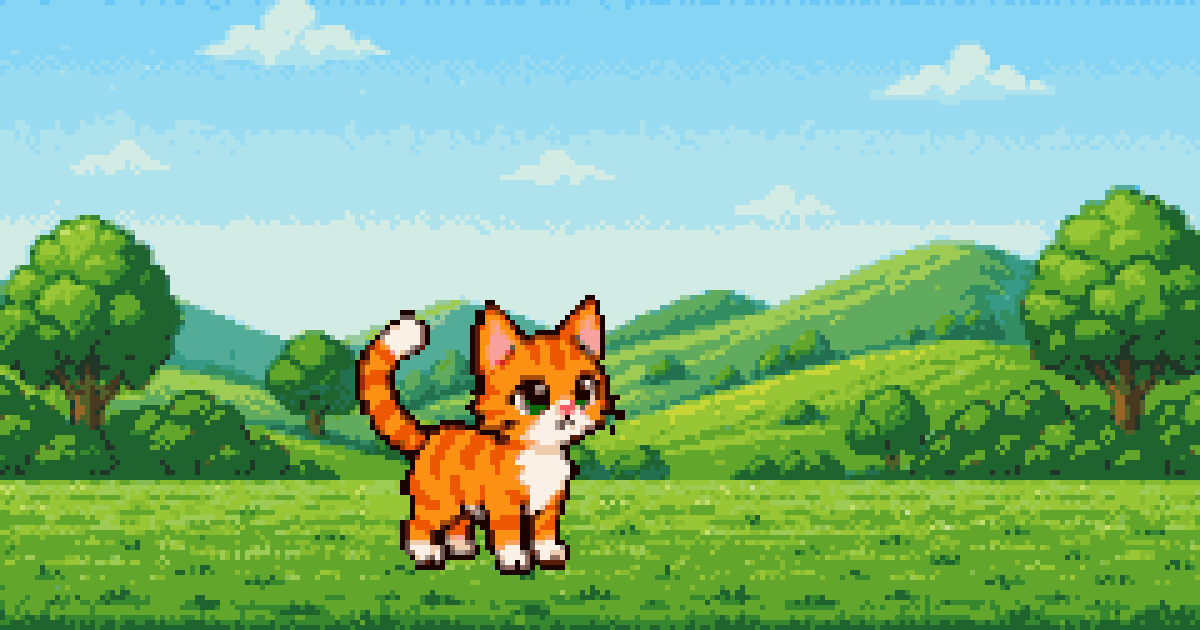
Every finished session brings treats. You feed the treats to your buddy, a cat, a dog or a fox.
| Session | Treats |
|---|---|
| 15 minutes | 3 |
| 25 minutes | 5 |
| 50 minutes | 10 |
| Break of at least 5 minutes within 2 hours after the session | +2 |
The buddy has a fullness value that drops by 4 points an hour around the clock, from full to empty in about a day. Each treat adds 10. Below 30 it is hungry, below 20 very hungry, below 10 it calls your friends for help. At night, from 22:00 to 7:00, it sleeps.
That changes the math above in two places.
First, the reward is no longer four days away. After 15 minutes there are 3 treats, and the buddy eats them right away. The important task now pays as fast as the inbox.
Second, “I should” turns into “someone is waiting”. A hungry buddy is not a reproach, it is a reason. About 65 focus minutes a day keep its fullness steady. That is one session of 50 minutes plus one of 15, or three of 25 plus a break. If you do not manage it, you find a hungry buddy, not a broken streak and not a counter reset to zero.
And when the buddy is hungry, you can pet it: +5 affection, every 5 minutes. That does not add fullness, but it is a reason to open the app, and whoever has the app open presses start more often.
What happens if you do nothing for a day?
Nothing bad. The buddy gets hungry, and that is all. Niven is not a trick that pushes you into more work. The buddy cannot die. There is no streak to break, no penalty for an empty day. If you do nothing for a week, it is hungry and glad when you come back. Friends can feed it in the meantime, and below a fullness of 10 it asks them by itself.
Notifications stay quiet: at most 4 a day, never before 8:00 and never after 21:00. If you want silence, switch them off, and the buddy waits anyway.
Keeping going is a different problem from starting
Starting is what the small timer solves. For keeping going over a week there is the weekly plan: every Sunday your buddy builds a plan with fixed blocks out of your sessions, your backlog and the tasks left over from last week. In the chat you can ask what is up on Monday or tell it what has changed. On the free plan that is 10 questions a day, on Pro 50.
But that is a topic for its own article. For today this is enough: the first step is the most expensive one. Make it small, make it measurable, and give it a reason that is not four days away.
Short answers
How long should the first focus session be?
15 minutes. That is the shortest length in Niven and small enough to agree to even on a bad day. If it keeps going afterwards, you start the next session.
What happens if I stop a session early?
There are no treats, and that is all. From one minute of running time the session still shows up in the time log, so the time is not lost.
How many treats does a session bring?
2 treats for 15 minutes, 3 for 25, 9 for 50. Long sessions pay off far more. A break of at least 5 minutes within 2 hours after the session adds 1.
Can the buddy starve?
No. Fullness drops to 0 and stays there. The buddy is hungry then, calls your friends for help below a fullness of 10, and eats as soon as you are back.
Is Niven free?
Yes, with the cat, all timer lengths and 10 chat questions a day. Pro adds the dog and the fox, 50 chat questions and a weekly plan you can rebuild any time; prices are on the product page.
Sources
- Steel, P. (2007). The nature of procrastination: A meta-analytic and theoretical review of quintessential self-regulatory failure. Psychological Bulletin, 133(1), 65 to 94. doi.org/10.1037/0033-2909.133.1.65
- Gollwitzer, P. M. (1999). Implementation intentions: Strong effects of simple plans. American Psychologist, 54(7), 493 to 503. doi.org/10.1037/0003-066X.54.7.493
- The numbers for treats, fullness and notifications are the app’s values as of September 2026.
All features with their numbers are on the product page, the short answers in the FAQ.